I have a backlog of posts to catch up on. Lots of pics too, so what I’m going to do is write an account of the incredible dives I had on Sunday and then tack on a pixel dump of shots from earlier dives over the past few weeks.
Saturday I got a text from a friend who told me a local 46 foot Newton dive boat was going out Sunday with the bare minimum of divers, and that there was plenty of space for me, him and his partner. OK! I got myself on the manifest and organized my gear and camera.
There is nothing as comfortable as being one of about 10 people, including crew, on a big dive boat. Usually, you get a tank station on the dive deck that’s a couple of feet wide, and in that space you have to assemble your rig, store your fins and wetsuit, and keep the deck clear for the other divers. Then you hope they do the same for you. It usually works out ok, but you’re still cramped, along with everyone else.
But on this day it was wide open spaces. Didn’t matter if you spread your whole kit out across four feet of bench space, nobody was going to need that space except you. Still, good habits apply and we made tight little piles of gear that collapsed into the 2 ft width of our tank stations, but there was none of the bumping collisions with others’ gear as you assemble you rig.
We discussed possible sites to dive and, it being one of the calmest days all spring in Kona, we could choose pretty much any spot we wanted. Laura P said she knew where there were some male Flame Wrasses. So first dive decision was made right there. We’d go look for those impossibly elusive and rare creatures. She described their location as a clump of rocks and coral about 75 feet deep, just south west of a big pinnacles we all knew.
Here's the Male Flame Wrasse. He isn't displaying his fins; they can look like sails, but he is a great specimen. On the way out to look for him we encountered so many other fabulous animals. Below they are: A Devil Scorpionfish, lurking with his camo completely blending him into the rocks, allowing him to wait for prey to swim by for the ambush. Just a moment later we found a very large Frogfish that, at first, I mistook for another Devil Scorpion due to his similar coloration. Out in the coral gardens covering the steep slope to the depths we often see Psychedelic Wrasses. They appear in groups of females and one male. Sometimes we get lucky and find psych babies. Here's one. Just beneath is a clutch of Spanish Dancer Nudi eggs. We call these "Sea Roses" and they are fairly rare.
Another baby fish we sometimes find is this baby Hogfish. They flit around the clumps of coral and rock and you spot them by their bright yellow band on their backs. Often we find magnificent growths of antler coral and around these are swarms of Hawaiian Dascillus, a kind of damsel fish. The Dascillus will make a kind of raspberry noise at you to display their displeasure at your presence. Here's one giving me a good side view.
Another interesting find are juvenile fish transitiioning from their baby colorations to their adult appearance. The mostly red fish below is a juvenile YellowTail Coris transtioning from baby to Adult.
Next we have a couple of related fish: an Orange spine Unicorn and an Orangeband Surgeon. They both have blades near their tailfins that they use for self defense.
Another fish related to the surgeons and unicorns is the Achilles Tang. I see them rarely though they are fairly common, they're just skittish and it's hard to get a shot of them. But I got this one displaying his beautiful orange teardrop coloation.
Continuing my lucky streak: a Female Whitley's Boxfish. These are rare, but they hang out in the same areas for long periods so we can find them occasionally. Here's one that appeared in a spot I didn't know to look for one. Out is the sandflats we look for Peacock Razor Wrasses. They like to skim along the sand and among small rock outcroppings. Here's a good one. Back in the coral I found this Potters Angelfish. Heading back to the shallows we looked under a ledge and found this brightly coloraed Common Bigeye. he was about two feet log.
A very common ambush predator, the Blackside hawkfish, likes to perch on coral outcroppings and jump on their lunch when it swims close by. They don't like camera flashes and will dart away if you get too close. Usuall get only one shot. here's one just milliseconds after he took off.
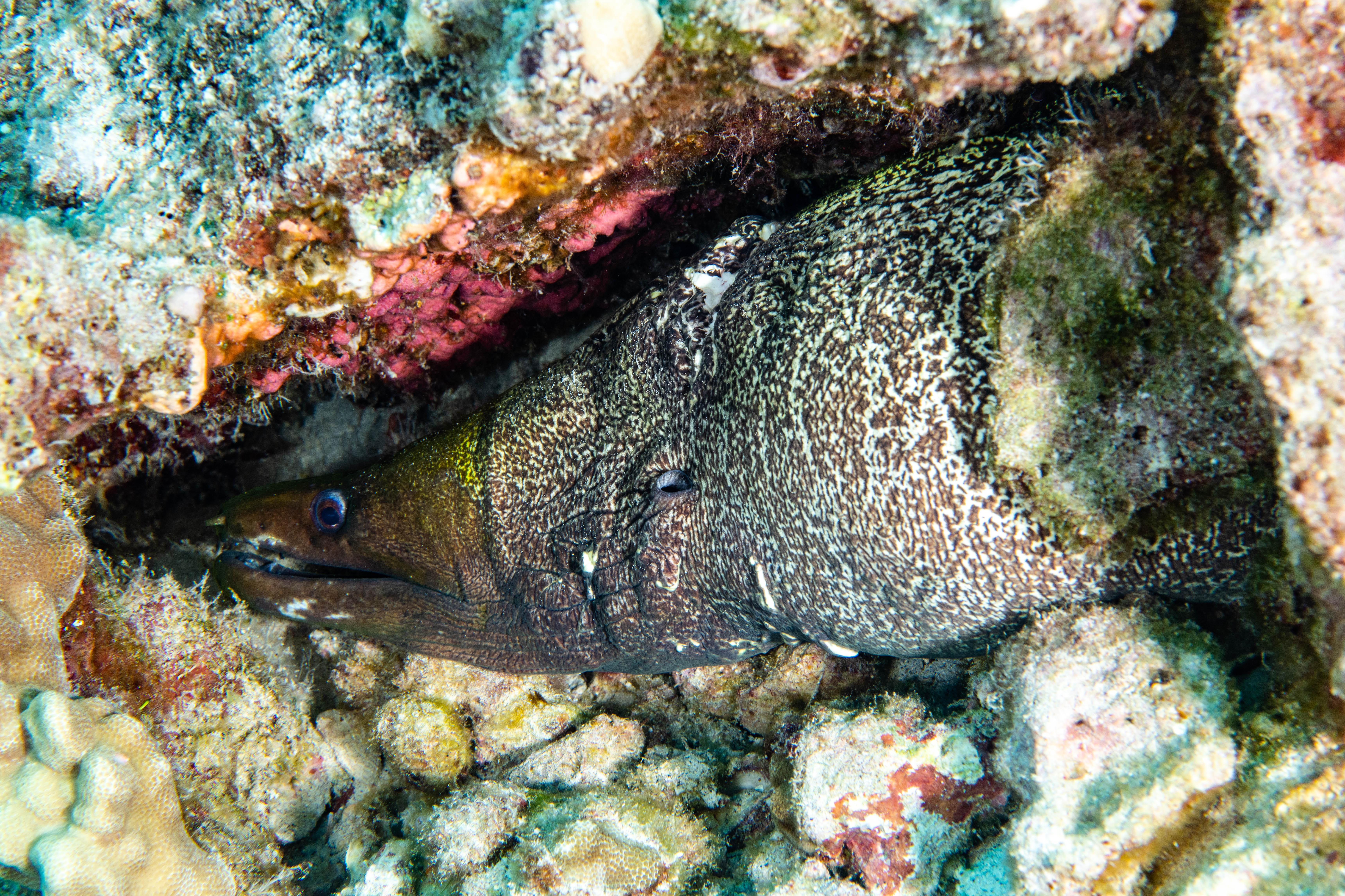
Another animal that stays put is the Lincya Star, also called Blood star. They are fairly rare. Here's one. This male Pencil Wrasse was trying to hide in some coral but I got this shot of him with his unique coloration. Another small animal with unique coloration is the Scrambled Egg Nudibranch. They actually are one of the largest nudis. This one was about 2 inches long. Finally, here's a very common White mouth eel sticking out of his hole to watch the passing show.
Now for the shots that I've taken over the past month or so, but was too tired or lazy to post.
Below another Devil Scorpion and a very well camoflaged Flowery Flounder. Have to mention that the very tiny yellow nudi with red trim is about the size of a grain of rice. We call them Rubber Duckys. They show up in summer.
Butterfly fish often appear in mated pairs. They follow each other and stay close to one another. Here are two of my favorites: Ornate Butterflies and Oval Butterflies. Just below, another ambush predator, the Reef Lizard. Also, a large Tiger Cowrie.
Have to mention the Snowflake Eel below. First one I've seen. They live in the sand and stick their noses out to see what's floating by, but divers scare them and they pop back in the sand. i was lucky to get this shot. Another beautiful butterfly: Threadfin Butterfly. See the thread fin trailing behind? One more thing to notice. Further below, an eel that it looks like had a big bite taken out of him. Not sure he was alive.
Above we saw a baby Psychedelic Wrasse transitioning to adult female. Here's an adult female. Below a Longspine Porcupine and, very awesome and rarew, a Male Whitley's Boxfish.
Tuesday, June 6, 2023
Wednesday, April 12, 2023
A dive family is a family
All of the Kona dive operators have club memberships available for Hawai'i Island residents, and these allow members deep discounts on dives and merchandise. But a few operators also set aside days of the week for club-only "ohana" charters, on which you can dive favorite moorings with old and new friends. One such operator is Kona Honu Divers, which offers Ohana charters mostly every Tuesday. I've been frequenting these charters for about the last four years, and enjoy friendships with most of the ohana divers that go back a ways, even before I started diving with Kona Honu.
So this morning I showed up at the slip, having made a reservation earlier, and schelepped my gear bags down to the landing. Skipper Johnny C and the rest of the crew were already there unloading tanks from the truck and loading tanks, diver gear, and supplies onto the boat.
The weather was variable, as it has been all year, partly sunny with cloud banks rolling down to the shore off the mountain.
As we drove out of the harbor and past the green can I noticed we were slanting off to the south, which means a likely first dive somewhere along the stretch of coast called Pawai Bay. Johnny picked one of the middle moorings and we hopped into the light morning surface chop and dropped onto the reef. Pawai bay features inshore cliffs and shallows with many big and small arches and caverns. Some of them, like the one at Airstation, are small eyelets connecting two larger expanses, and when there is surge you can position yourself to get shot out of one side and into the other. I don't much like to do this with a camera, but it's a fun thing.
Today, we initially angled along the cliff face and did a few swim-throughs before heading out into deeper water. The other thing about Pawai Bay is that, if you swim southwest over the steeply sloping, luxurious reef of mostly finger coral you will find yourself quickly dropping into the blue water abyss. This is a place where I've seen whales, Hammerhead sharks, and other pelagics. Spotted Eagle Rays are common.
On the reef we find every fish species found in Kona waters, including all the butterflies, Angelfish including Flame Angels, and all manner of Wrasses. One common species of Wrasse to be found there are the Psychedelic Wrasses. They get the name from the crazy red and polkadot heads of the males. They're also hermaphroditic, so that when a male is lost one of his harem of females becomes the male and off they go a restored family. A harem of Psychedelics is featured in the video if you scroll down.
My first cool fish of the day was this Potter's Angelfish. They too live in harems, with the males being identified by larger dark patches on their sides.
Very frequent on our reefs are the Common Longnose Butterflies, of which this is one. We also have a larger cousin called the "Big" Longnose Butterfly. It can be distinguished by the small dark dots extending back behind the dorsal fins.
Parrot fish are critical to the health of our reefs; they scour the rocks of algae and poop out the sand we find on the bottom. here's an Ember Parrot doiong its thing. Hardly a minute goes by on a reef dive where i don't see an Ornate Butterfly. This was the first fish I saw when I started diving here that made me go, "Whoa, what was that?" I still think they are very pretty. here's one. It's still spring and not really nudibfranch season, which is summer, but other divers are finding them, just not me. I did find a very common, large (2 inch) Scrambled Egg nudi. I've forgotten it's scientific name becsause I just don't care.
We have a couple of common hawkfish here that, if you read my blog, you've seen a million times already. I thiink they are pretty, and they sit on coral tendrils waiting for lunch to swim by. I sneak up on them and get the one shot I can get before they dart off down the reef looking for a less busy perch to sit on. This one is an Arceye Hawkfish."
Now for a fish I'd never seen before: a Lobel's Lizardfish. Very common here are the Reef Lizards, but the Lobels have different eyes. I was stoked to find this fish and check off another box on my "fish I haven't seen yet" list. A fish I can't seem to resist shooting is this Orangespine Unicorn. I think they are so beautiful.
Off we go to another spot along the Kona coast, this time up north to a stretch of coast called O'oma. There are six moorings along this coast, and it's also a good surfing area. We dropped onto a site that features a large and intricate inshore cave-lavatube system that you can only explore when the surge and swell are very slight. We elected to go deeper first and then spend the remainder of the dives in the shallow swimthroughs. Out on the reef I found this Ringtail Wrasse. See the white ring around its tail? Peeping out from under a ledge was this Spotted Boxfish, less rare than the Whitleys but still a nice fish to capture on film. Our dive guide Bob P signaled me to go look in a hole he'd just glided past. I looked. It was in between two walls and there was enough surge to keep me from getting to the hole. When I did I saw this magnificent Tiger Cowrie, and I took my only shot as I was being propelled past the hole by the surge.
As we wandered back toward the shallows it seemed as though the current we'd felt earlier and the surge had abated a bit, and we were able to get into the lava tubes and overhangs to see what we could find. One thing we always look for in a deep fissure with a sand bottom are White tip Reef Sharks. Today there was only one. I had my macro lens so only got the front half of this one. The video shows its whole body. They sleep under the ledges, and we try not to wake them with too much thrashing and kicking up sand.
Here's the video of the day.
So this morning I showed up at the slip, having made a reservation earlier, and schelepped my gear bags down to the landing. Skipper Johnny C and the rest of the crew were already there unloading tanks from the truck and loading tanks, diver gear, and supplies onto the boat.
The weather was variable, as it has been all year, partly sunny with cloud banks rolling down to the shore off the mountain.
As we drove out of the harbor and past the green can I noticed we were slanting off to the south, which means a likely first dive somewhere along the stretch of coast called Pawai Bay. Johnny picked one of the middle moorings and we hopped into the light morning surface chop and dropped onto the reef. Pawai bay features inshore cliffs and shallows with many big and small arches and caverns. Some of them, like the one at Airstation, are small eyelets connecting two larger expanses, and when there is surge you can position yourself to get shot out of one side and into the other. I don't much like to do this with a camera, but it's a fun thing.
Today, we initially angled along the cliff face and did a few swim-throughs before heading out into deeper water. The other thing about Pawai Bay is that, if you swim southwest over the steeply sloping, luxurious reef of mostly finger coral you will find yourself quickly dropping into the blue water abyss. This is a place where I've seen whales, Hammerhead sharks, and other pelagics. Spotted Eagle Rays are common.
On the reef we find every fish species found in Kona waters, including all the butterflies, Angelfish including Flame Angels, and all manner of Wrasses. One common species of Wrasse to be found there are the Psychedelic Wrasses. They get the name from the crazy red and polkadot heads of the males. They're also hermaphroditic, so that when a male is lost one of his harem of females becomes the male and off they go a restored family. A harem of Psychedelics is featured in the video if you scroll down.
My first cool fish of the day was this Potter's Angelfish. They too live in harems, with the males being identified by larger dark patches on their sides.
Very frequent on our reefs are the Common Longnose Butterflies, of which this is one. We also have a larger cousin called the "Big" Longnose Butterfly. It can be distinguished by the small dark dots extending back behind the dorsal fins.
Parrot fish are critical to the health of our reefs; they scour the rocks of algae and poop out the sand we find on the bottom. here's an Ember Parrot doiong its thing. Hardly a minute goes by on a reef dive where i don't see an Ornate Butterfly. This was the first fish I saw when I started diving here that made me go, "Whoa, what was that?" I still think they are very pretty. here's one. It's still spring and not really nudibfranch season, which is summer, but other divers are finding them, just not me. I did find a very common, large (2 inch) Scrambled Egg nudi. I've forgotten it's scientific name becsause I just don't care.
We have a couple of common hawkfish here that, if you read my blog, you've seen a million times already. I thiink they are pretty, and they sit on coral tendrils waiting for lunch to swim by. I sneak up on them and get the one shot I can get before they dart off down the reef looking for a less busy perch to sit on. This one is an Arceye Hawkfish."
Now for a fish I'd never seen before: a Lobel's Lizardfish. Very common here are the Reef Lizards, but the Lobels have different eyes. I was stoked to find this fish and check off another box on my "fish I haven't seen yet" list. A fish I can't seem to resist shooting is this Orangespine Unicorn. I think they are so beautiful.
Off we go to another spot along the Kona coast, this time up north to a stretch of coast called O'oma. There are six moorings along this coast, and it's also a good surfing area. We dropped onto a site that features a large and intricate inshore cave-lavatube system that you can only explore when the surge and swell are very slight. We elected to go deeper first and then spend the remainder of the dives in the shallow swimthroughs. Out on the reef I found this Ringtail Wrasse. See the white ring around its tail? Peeping out from under a ledge was this Spotted Boxfish, less rare than the Whitleys but still a nice fish to capture on film. Our dive guide Bob P signaled me to go look in a hole he'd just glided past. I looked. It was in between two walls and there was enough surge to keep me from getting to the hole. When I did I saw this magnificent Tiger Cowrie, and I took my only shot as I was being propelled past the hole by the surge.
As we wandered back toward the shallows it seemed as though the current we'd felt earlier and the surge had abated a bit, and we were able to get into the lava tubes and overhangs to see what we could find. One thing we always look for in a deep fissure with a sand bottom are White tip Reef Sharks. Today there was only one. I had my macro lens so only got the front half of this one. The video shows its whole body. They sleep under the ledges, and we try not to wake them with too much thrashing and kicking up sand.
Here's the video of the day.
Subscribe to:
Posts (Atom)